
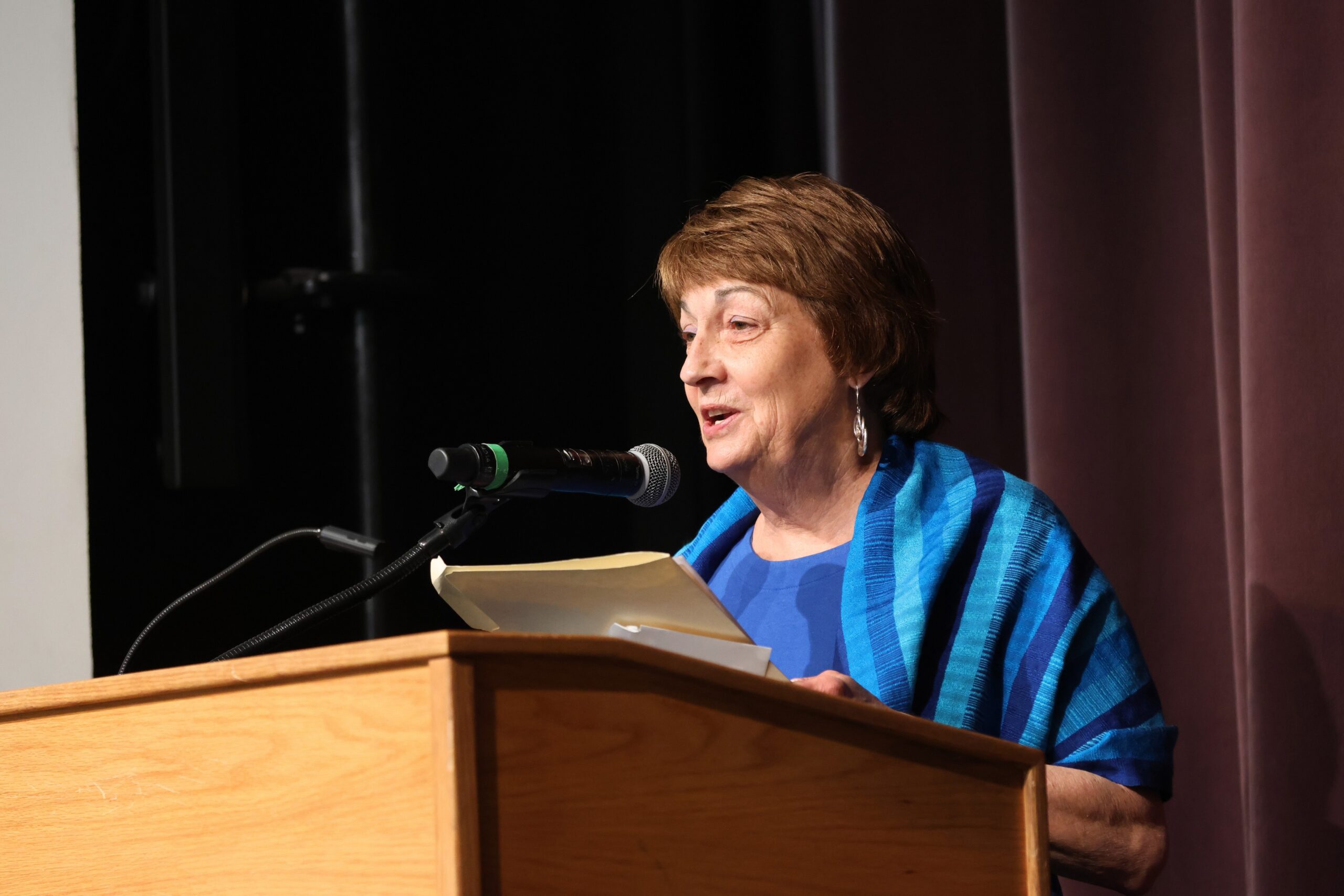
CLLAS is proud to celebrate Dr. Lynn Stephen, co-founder of the Center for Latino/a and Latin American Studies and Distinguished Professor of Anthropology at the University of Oregon, on her election to the American Academy of Arts and Sciences. Founded in 1780, the American Academy of Arts and Sciences honors excellence and brings together leaders across fields to examine new ideas and address issues of importance to the nation and the world.
In its election letter, the Academy wrote, “This honor signifies the high regard in which you are held by leaders in your field and members throughout the nation.” Stephen will be inducted as part of the 2026 class during the Academy’s Induction Weekend in Cambridge, Massachusetts, October 9 through 11, with the formal ceremony taking place on Saturday, October 10.
Stephen joins a 2026 class of 252 new members elected across academia, the arts, industry, journalism, philanthropy, policy, research, and science. Other newly elected members include actor and filmmaker Jodie Foster, actor, dancer, and singer Rita Moreno, authors Barbara Kingsolver and Colson Whitehead, art critic and curator Nicole Fleetwood, anthropologist and ethnographer John L. Jackson, environmental scientist and GIS technologist Jack Dangermond, and computer scientist and entrepreneur Shwetak Patel.
Stephen’s election recognizes a career shaped by rigorous scholarship, public engagement, and longstanding commitments to immigrant, Indigenous, Latin American, and Latinx communities. Her work as an ethnographer has taken her across Mexico, Guatemala, Brazil, Chile, El Salvador, and the United States, where she has spent more than four decades studying how communities organize, remember, resist, care for one another, and create meaning across borders. That same commitment helped shape the foundation of CLLAS. Reflecting on the center’s beginnings, Stephen worked with others to begin creating an intellectual community and collaborative research space that would connect UO faculty, students, and administrators to Latino and Latin American communities in Oregon, the United States, and abroad.
The life of CLLAS began in fall 2007, when an official advisory board formed with faculty and leaders across multiple fields. On April 24, 2010, CLLAS formally launched at a family-friendly event at the Jordan Schnitzer Museum of Art with board members, community activists, students, and supporters. What began as a small center incubated with the support of the Center for the Study of Women in Society grew into an independent research center with permanent funding, staff, graduate student support, research action projects, public programming, and strong connections across Oregon, the United States, and Latin America.
Stephen has always described the founding vision of CLLAS as hemispheric, bringing together Latino/a and Latin American studies across “many different borders, disciplines, and perspectives.” That vision continues to define the center’s work today. From its earliest years, CLLAS has supported graduate student and faculty research, community collaborations, public events, and research action projects focused on issues including Indigenous and Afro-descendant communities, Latino equity in Oregon, human rights, social memory, and Latino history. Stephen’s broader scholarly work reflects this same collaborative and community based approach.
In her acceptance letter to the Academy, Stephen reflected on the many people and communities who have shaped her intellectual life. She wrote that her scholarly kin include “people who speak dozens of languages, including a wide range of Indigenous languages, colonial and national languages, and the languages of emotion and connection.” For Stephen, scholarship has never been separate from the communities, students, colleagues, families, and collaborators who make knowledge possible. Her current research continues this legacy.
Through the collaborative project “Invisible No More: Mobilizing Mesoamerican Indigenous Knowledges for Health and Socio-Environmental Justice,” Stephen and her research team have worked with community partners to document Mesoamerican Indigenous languages in Oregon, gather narratives of health, care, medicinal plant knowledge, and mutual aid, and support access to culturally and linguistically relevant resources. The project has identified 50 Indigenous languages from Mexico and Guatemala spoken in Oregon and has included surveys, oral histories, interviews, and audio resources created in Indigenous languages.
As political conditions shifted and immigrant communities faced increased enforcement and fear, Stephen and her collaborators also rethought what public scholarship requires in moments of crisis. In her essay, Political Solidarity and the Life of the Mind in Activist and Collaborative Research, Stephen describes the responsibility of researchers to protect communities while also challenging harmful public narratives about immigrants. She writes, “We need to document what is happening, tell these stories to the public, and try to change the public discourse on immigrants as criminals before they even arrive.”
Stephen’s election to the American Academy of Arts and Sciences honors not only her scholarly contributions, but also the deeply collaborative, community centered, and justice oriented approach that has defined her career. It also offers a moment to recognize her lasting impact at the University of Oregon, including her role in helping build CLLAS as a thriving research center dedicated to scholarship, teaching, public engagement, and community connection. CLLAS congratulates Dr. Lynn Stephen on this extraordinary recognition and celebrates the lasting impact of her work at the University of Oregon and far beyond.
About Dr. Lynn Stephen
Dr. Lynn Stephen is Distinguished Professor of Anthropology at the University of Oregon and co-founder of the Center for Latino/a and Latin American Studies. Her research focuses on Indigenous peoples, migration, gender, social movements, labor, and transborder communities in Latin America and the United States. Across more than four decades of scholarship, teaching, public engagement, and collaborative research, Stephen has worked closely with immigrant, Indigenous, Latin American, and Latinx communities. Her work has helped shape CLLAS as an interdisciplinary center committed to community accountability, hemispheric research, and scholarship that reaches beyond the university.