Latine Worldmaking: Queer Ecologies, Migration, and Belonging
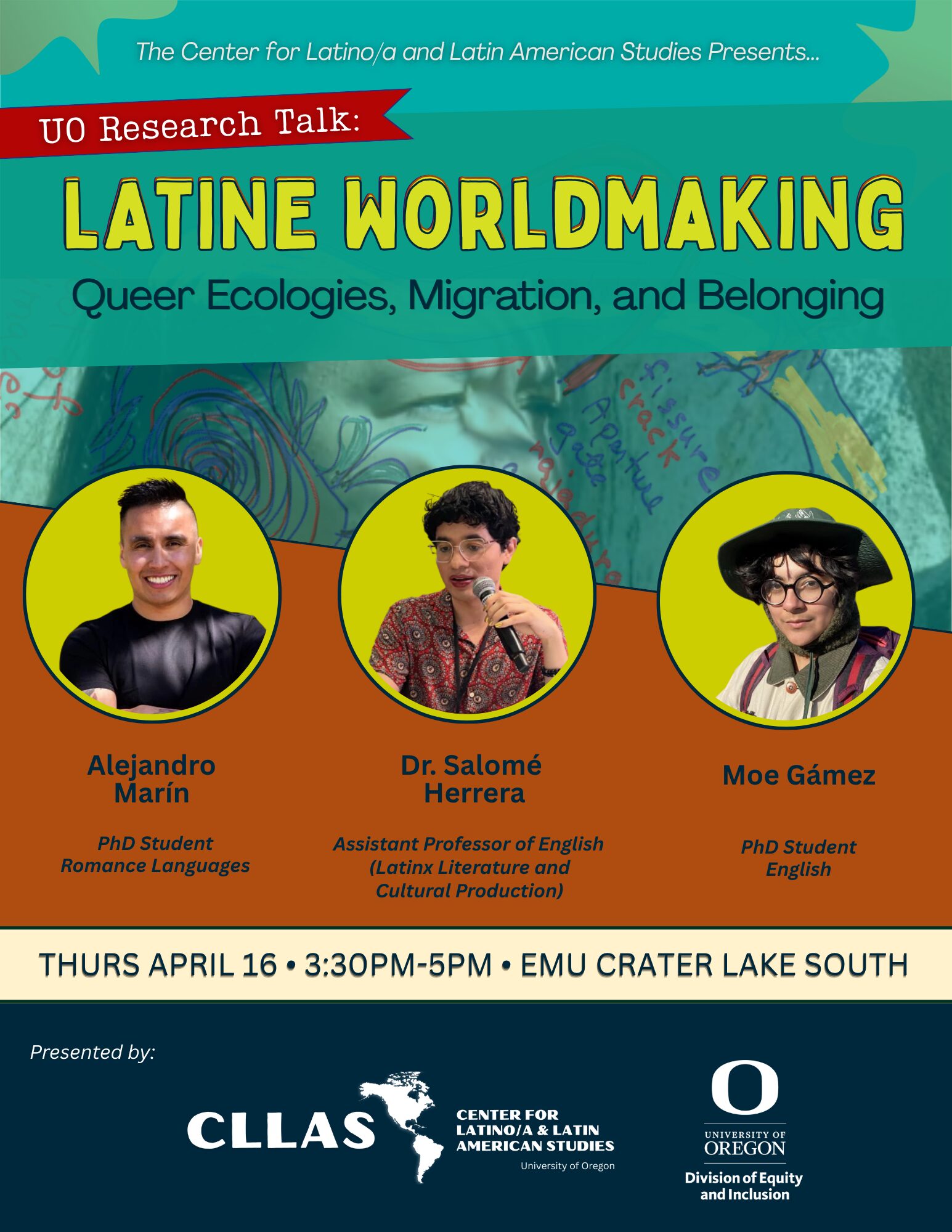
📅 Thursday, April 16
⏰ 3:30 PM–5:00 PM
📍 EMU Crater Lake Room (Room 145), University of Oregon
📍 1395 University Street, Eugene, OR 97403 (Room 145)
The Center for Latino/a and Latin American Studies (CLLAS) is pleased to host a research colloquium featuring faculty and graduate student scholars whose work explores how migration, embodiment, environment, and cultural production shape Latine experiences of belonging. Through literature, media, performance, and critical theory, this event highlights interdisciplinary approaches to identity, place, and community across Latinx and Latin American contexts.
- Dr. Salomé Herrera is a faculty member in the Department of English at the University of Oregon whose research is rooted in literary, performance, and Latinx studies. In their talk, Trans* Epistemologies: Tracing the Womb across the Gloria Evangelina Anzaldúa Papers, Herrera traces an embodied trans* epistemology across the Gloria Evangelina Anzaldúa Papers from the Benson Library at the University of Texas at Austin. They specifically examine the development of Anzaldúa’s conceptualization of “el cenote,” Mexican lime hole sinkholes with spiritual significance for Mayan cultures, understood as material reservoirs or “wombs” of the collective unconscious from which creativity emerges. Drawing across spiritual and materialist traditions, Herrera shows how a sense of transitivity emerges from a queer Chicana feminist understanding of evolution, ultimately arguing that Anzaldúa’s speculative world-building transforms the womb from a colonized site of carceral policing into one of communal creativity with decolonial potential.
- Alejandro Marín is a doctoral candidate in Romance Languages at the University of Oregon whose research focuses on contemporary migrant narratives from Cuba, the Dominican Republic, and Equatorial Guinea. His dissertation, The New Errancy: Configurations of Contemporary Migrant Literature in Cuba, the Dominican Republic, and Equatorial Guinea, develops “The New Errancy” as an analytical category to examine how authors from three distinct migration contexts challenge traditional colonial axes, reimagine non-biological family formations, and construct transnational identities in solidarity with contemporary migrants. Supported by the CLLAS Graduate Research Grant, Marín conducted archival research in the Dominican Republic, interviewed author José Acosta, and observed cross-border dynamics at Dajabón, grounding his work in lived migration contexts. The chapter he presents reads Loida Maritza Pérez’s Geographies of Home as a meditation on how transnational Dominican families negotiate generational fracture, linguistic displacement, and the contested meaning of belonging between the island and the United States.
- Moe Gámez is a doctoral student in English at the University of Oregon whose research explores the intersection of Latinx literature, environmental justice, and queer/trans theory. Their dissertation examines how queer and trans Latinx authors and artists represent ecologies through embodied, speculative, and political narratives. Through archival and literary analysis, Gámez’s work contributes to the growing subfield of queer and trans Latinx environmentalisms, highlighting how questions of environment, identity, and embodiment are deeply interconnected.
Together, these scholars offer interdisciplinary perspectives on how Latine communities and cultural producers negotiate identity, space, embodiment, and belonging in relation to migration, ecology, and social transformation. Please join us for this engaging conversation and opportunity to learn more about emerging faculty and graduate student research at the University of Oregon. This event is presented by the Center for Latino/a and Latin American Studies (CLLAS).