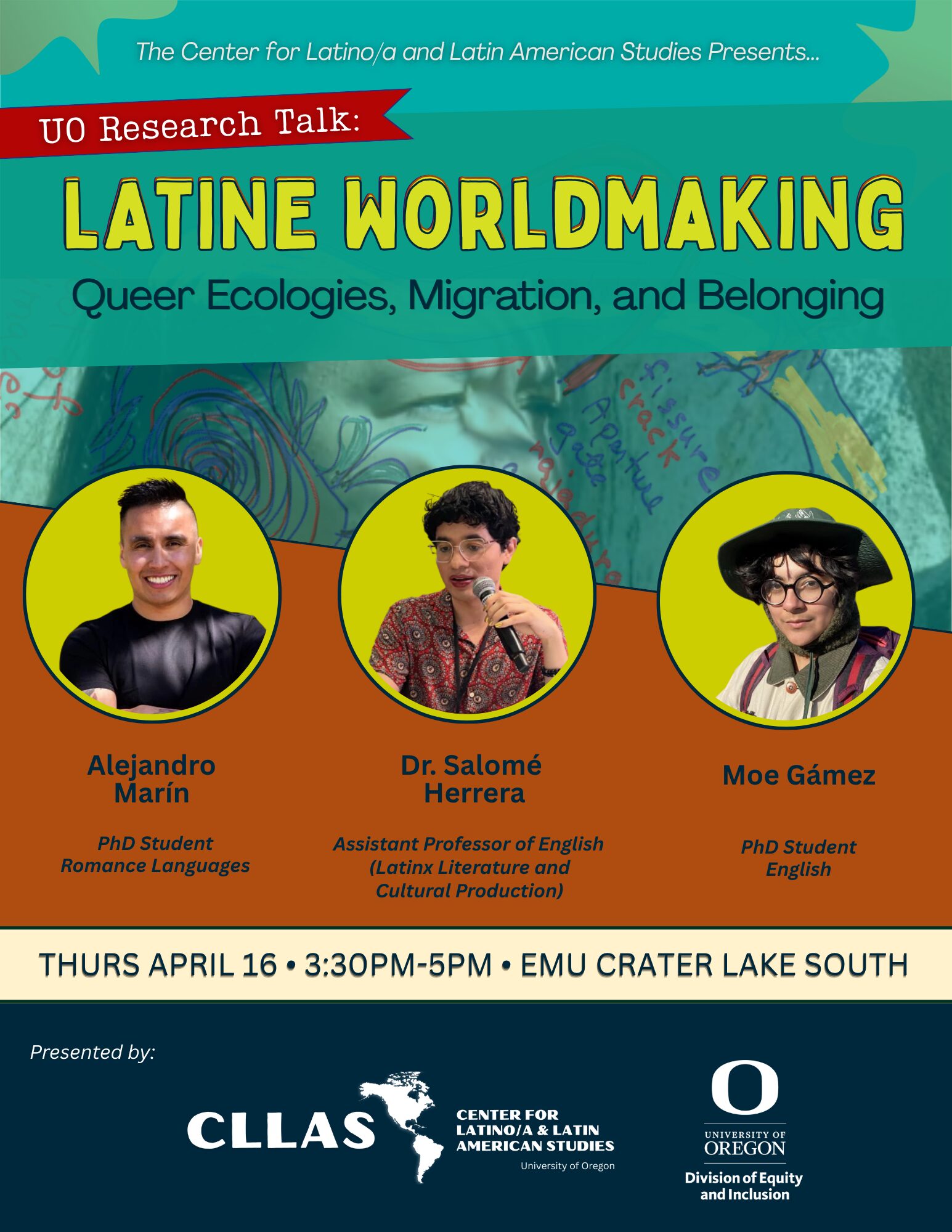
Latine Worldmaking: Queer Ecologies, Migration, and Belonging
📅 Thursday, April 16
⏰ 3:30 PM–5:00 PM
📍 EMU Crater Lake Room, University of Oregon
The Center for Latino/a and Latin American Studies (CLLAS) is pleased to host a research colloquium featuring faculty and graduate student scholars whose work explores how migration, embodiment, environment, and cultural production shape Latine experiences of belonging. Through literature, media, performance, and critical theory, this event highlights interdisciplinary approaches to identity, place, and community across Latinx and Latin American contexts.
- Dr. Salomé Herrera is a faculty member in the Department of English at the University of Oregon whose research is rooted in literary, performance, and Latinx studies. Their current project examines how Latinx artists engage questions of borders, transgender identity, and reproductive freedom through literature, media, and performance art. Drawing on the work of Gloria Anzaldúa and queer feminist theory, Herrera explores how artists imagine care, creativity, and collective life as forms of Latine worldmaking.
- Alejandro Marín is a PhD student in Romance Languages at the University of Oregon whose research focuses on contemporary migrant narratives from Cuba, the Dominican Republic, and Equatorial Guinea. His project examines how migration reshapes family, diasporic identity, and the meaning of home through literary analysis, archival research, and fieldwork. Centering the Dominican Republic, Marín explores how transnational movement and border spaces inform contemporary understandings of belonging.
- Moe Gámez is a doctoral student in English at the University of Oregon whose research explores the intersection of Latinx literature, environmental justice, and queer/trans theory. Their dissertation examines how queer and trans Latinx authors and artists represent ecologies through embodied, speculative, and political narratives. Through archival and literary analysis, Moe’s work contributes to the growing subfield of queer and trans Latinx environmentalisms.
Together, these scholars offer interdisciplinary perspectives on how Latine communities and cultural producers negotiate identity, space, embodiment, and belonging in relation to migration, ecology, and social transformation. Please join us for this engaging conversation and opportunity to learn more about emerging faculty and graduate student research at the University of Oregon.
This event is presented by the Center for Latino/a and Latin American Studies (CLLAS).